
Despite President Trump's optimistic prediction of a swift resolution to the ongoing conflict with Iran, Tehran dismisses any possibility of diplomatic breakthroughs, citing deep distrust and highlighting the complexities of US-Iran relations.

Indian equity benchmarks, Sensex and Nifty, ended lower after a spectacular rally, with the Sensex tumbling 931 points, as renewed tensions in West Asia, particularly the risk to the ceasefire deal after Iran closed the Strait of Hormuz, dampened investor optimism.

A Pakistani delegation, led by Army Chief Field Marshal Asim Munir, has arrived in Tehran to mediate the ongoing conflict between the US and Iran, following initial talks in Islamabad.

Israeli Prime Minister Benjamin Netanyahu on Thursday called for the opening of direct negotiations with Lebanon, as tensions persist along the border despite a two-week ceasefire aimed at halting hostilities in West Asia.

Small- and midcap stocks have delivered their biggest monthly rally in 12 years, but rising oil prices and global tensions could make the road ahead volatile.

Analysts predict that the ongoing conflict in West Asia, crude oil prices, and global trends will significantly influence the Indian stock market in the upcoming holiday-shortened week. Foreign investor activity and rupee movement will also be crucial.

Indian benchmark indices Sensex and Nifty experienced declines due to a sharp rally in crude oil prices, continuous foreign fund outflows, and geopolitical uncertainties. Regulatory developments in the banking sector, particularly the implementation of the Expected Credit Loss (ECL) framework, also contributed to the selling pressure.
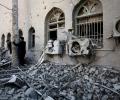
The logic of war plus the gathering storms in US politics as the midterms loom large leave him with no real alternative but to negotiate, points out Ambassador M K Bhadrakumar.

Iranian Foreign Minister Abbas Araghchi visited Pakistan for the second time in three days amid uncertainty surrounding potential peace talks with the US. The visit follows discussions in Oman regarding regional security and efforts to resolve the Iran-US conflict.

US President Donald Trump has indefinitely extended the ceasefire with Iran at the request of Pakistan, aiming to allow Tehran's leadership time to form a unified proposal to end the seven-week war.

The embassy also said that the exit must be undertaken in coordination with the mission.

Foreign investors have aggressively sold off Indian equities, withdrawing over 48,213 crore in the first 10 days of April, following a record 1.17 lakh crore outflow in March, driven by escalating geopolitical tensions in West Asia, rising crude oil prices, and global inflation concerns.

10 stocks from the Nifty 200 index that offer good growth potential and scope to deliver decent returns from current levels, based on brokerage estimates.

Benchmark indices Sensex and Nifty experienced a significant decline, falling over 1 per cent due to foreign fund outflows and global uncertainties.

Trump seems to have estimated that Ghalibaf is a pragmatic politician who is receptive to close relations with the US and is enthusiastic about fostering business and economic ties in particular, points out Ambassador M K Bhadrakumar.

The intriguing bit is that Trump is likely to attend the talks in Islamabad this weekend -- if he does, it will be the clearest signal yet that the US is ready to exit the war with some sort of win to show, since he cannot afford to go for the talks and return empty-handed, notes Prem Panicker in his must read blog on the Iran War

Analysts say long-term investors may still benefit, but recommend limiting bullion exposure to around 10 per cent.

Chinese President Xi Jinping has called for the Strait of Hormuz to remain open for normal passage of ships, describing it as an 'international waterway' amid rising tensions between the US and Iran.

There are enough people at the top decision-making level in Tehran who are still willing to negotiate, provided Trump can create the right setting for the negotiation to acquire a dynamic of its own, points out Ambassador M K Bhadrakumar.

Former US President Donald Trump claimed victory over Iran, stating they agreed to never have a nuclear weapon and provided a 'significant prize' related to the Strait of Hormuz. He also suggested a change in Iranian leadership and acknowledged Pakistan's role in facilitating talks.

'As re-industrialisation gathers pace across regions like Asia, Europe and the US, a wide range of products and inputs will see demand.'

'Existing investors who have not acted so far may consider holding on to these funds with the understanding that the higher returns they expected from them may now take longer to materialise.'

Trump's remarks marks one of the most direct rebukes yet from Washington to its allies over their refusal to support US-led military operations in Iran and over the energy crisis triggered by disruptions in the Persian Gulf.

Pakistan is set to host the foreign ministers of Saudi Arabia, Egypt, and Turkiye to discuss a range of issues, including de-escalating tensions in West Asia.

Gold extended its record-breaking run to breach the Rs 1.5 lakh per 10-gram mark in futures trade on Tuesday, while silver surged to a lifetime high of Rs 3.27 lakh per kg as investors rushed to safe-haven assets amid mounting global tensions. On the Multi Commodity Exchange (MCX), gold futures for February delivery climbed Rs 6,861, or 4.7 per cent, to record Rs 1,52,500 per 10 grams after settling at Rs 1,45,639 per 10 grams in the previous session.

US Vice President JD Vance leads a delegation to Islamabad for talks with Iran, expressing optimism while warning against bad faith negotiations from Tehran.

Indian equities on Dalal Street saw volatility as global market trends and fresh tariff concerns linked to Donald Trump impacted investor sentiment. Track Sensex, Nifty50 movement and key market drivers for Feb 24, 2026.
Equity benchmark indices Sensex and Nifty experienced a significant decline, primarily driven by a selloff in IT stocks due to concerns about AI disruption and renewed worries over global trade.

The core issues to be settled -- access to Hormuz, Israel's aggression in Lebanon, the question of Iran's nuclear programme, sanctions relief and compensation -- are thorny enough to require weeks of patient negotiation. The most likely outcome of the opening sessions is that both sides take the measure of each other, establish what is and is not negotiable, and return home without having broken anything. That would count as progress.

The delegations from the US and Iran head to Islamabad on Friday, carrying a ceasefire that is already fraying, a Strait that is technically open and practically closed, and a negotiating agenda that would challenge even parties actually negotiating in good faith, which these groups are not. Prem Panicker continues his must read blog on the Iran War.

'Refiners may soon be forced to adjust operations, curtailing runs as product exports stall and directing output solely to domestic markets.'

Iran's football federation is in discussions with FIFA about moving their World Cup matches from the United States to Mexico due to concerns about the safety of their players, Iranian football president Mehdi Taj said.

According to a statement, the move follows rigorous monitoring of digital platforms to combat the spread of fabricated information and artificial content intended to incite public disorder and undermine general stability.

If the Iranian regime needs to be punished for promoting quasi-terrorist outfits like Hezbollah and Hamas, then what about Pakistan which has spent decades exporting terror around the world, killing thousands, particularly in Afghanistan and India? asks M R Narayan Swamy.
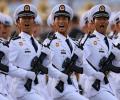
China's latest defence budget surges to $275 billion, fueling its ambitious military modernisation program and intensifying geopolitical dynamics in the region.

Israel has for more than two decades and several US presidencies worked to draw the United States into a full-scale war with Iran. Having finally achieved that, the last thing it wants is Trump declaring victory and going home, as he is prone to do. Ali Larijani was the figure most capable of handing Trump a negotiated exit with something to show for it. Without Larijani, the road to an exit gets considerably narrower. Prem Panicker continues his must read daily blog on the Gulf War.

The pause gives the US time to breathe, to regroup, to move its expeditionary force into position without risk of interception along the way. It gives Iran nothing -- on the ground, attacks against its infrastructure continue apace. Prem Panicker in his must read daily blog on the Gulf War.

The 'rescue' operation occurred within kilometres of Iran's underground tunnel complex at Isfahan, assessed by the IAEA and US intelligence as holding a substantial portion of the country's 60 per cent enriched uranium stockpile. Retired senior US military officers have highlighted that the mission's footprint -- hundreds of special operators, multiple heavy-lift aircraft deep inside Iran -- appears outsized for recovering a single airman. Prem Panicker continues his must read blog on the Iran War.

Iran is fighting a different war: Older, slower, and in some ways more dangerous. Iran doesn't need to shoot down an F/A-18. It only needs to make the Strait of Hormuz feel dangerous long enough for insurance markets, shipping companies, and oil futures traders to do the rest. Prem Panicker continues his must-read daily blog on the war in the Middle East.

Aseem Chhabra lists his top 10 films from this year's Sundance festival, a blend of narratives and documentaries made in the US and other parts of the world.
